You
could almost sense how it was expecting at any moment to be caught
and punished for the path it had chosen. A few steps forward and
then stop, wait, and then a few more steps. Repeat.
Danger
was close, the ant could sense that, but the threat was so big and so
close that it could not see it, could not take it all in.
It
kept moving forward, stayed on mission.
I
had to resist the urge to flick the little soldier away—send him
flying as some object lesson in the importance of perspective and
operational awareness. As though, in his little ant-brain, he would
recognize, as he sailed through the air, that he had unwittingly
crawled right into the beast's maw and then vow never to make the
same mistake again just before slamming into some vertical surface
and being rendered senseless.
“Oh,
I see it now,” the suddenly flying ant would say.
“Gosh,
that was pretty risky. Probably shouldn't ever do that again. And
now I won't, because I'm dead.”
No,
I wasn't going to flick and I wasn't going to kill. At that moment,
I had too much in common with that ant. I knew too well what it was
like to find yourself in the middle of the enemy when he wakes up to
your presence. I knew something about perspective and how, like fine
sand, it can so easily slip through your fingers.
The
ant was on a mission and I had it in my power to allow him to
complete that mission and, given my present circumstances, it seemed
only fair. Thanks to me, this one time, one operator was going to
make it home, was going to live to see another day.
I
was definitely softening.
We've
all seen those movies where they bend over backward to tell you the
one thing the hero must never ever do and then they put him in a
situation where that one thing is the only thing he can do.
If
people did exactly as they were told all the time you and I would not
be having this conversation. This, this thing we have, would have
been decided a long time ago before either of us knew a thing about
the other.
One,
or both of us, wound have been sent home, pulse optional.
Operators
don't follow orders, don't color within the lines, and speak before we
are spoken to. When you talk about somebody having to be ready to
make the first move, those are operators.
The
ant was an operator.
I'm
not a bug guy, but I know that ant would have known it was out of his
element the moment one of his legs touched my skin. He could have
pulled out and re-routed, but he came ahead: that's an operator.
One
time, I was in a boat with some more fucking Albanians—it was
always Albanians, like nobody else was so stupid, or that greedy to
take our people out from under. The
boat reeked of fish and so did the crew. It was like they bathed in
the shit.
To
them, I was just another piece of illicit cargo that they were getting
paid to ferry across the Baltic. They were a very expensive, very
private, taxi service, but, as they made it clear, they were not being
paid anything close to enough to risk running into the wrong people.
At the first sign of trouble, they were going to cut me open and
throw me over the side.
Our
people were afraid of them, couldn't stand them. They relied on them
regularly, but they didn't like them and certainly never trusted
them. Which
always made me feel good when I kept finding myself in their boats.
Fucking
Albanians.
I
don't know what made me angrier, my people, or theirs.
Anyway--I
know this is not what you asked about, but I'm going to tell you
anyway.
Yet
another stinky fishing boat and more stinkier Albanians and, as
always seemed to be the case when I was traveling in their care,
another winter storm.
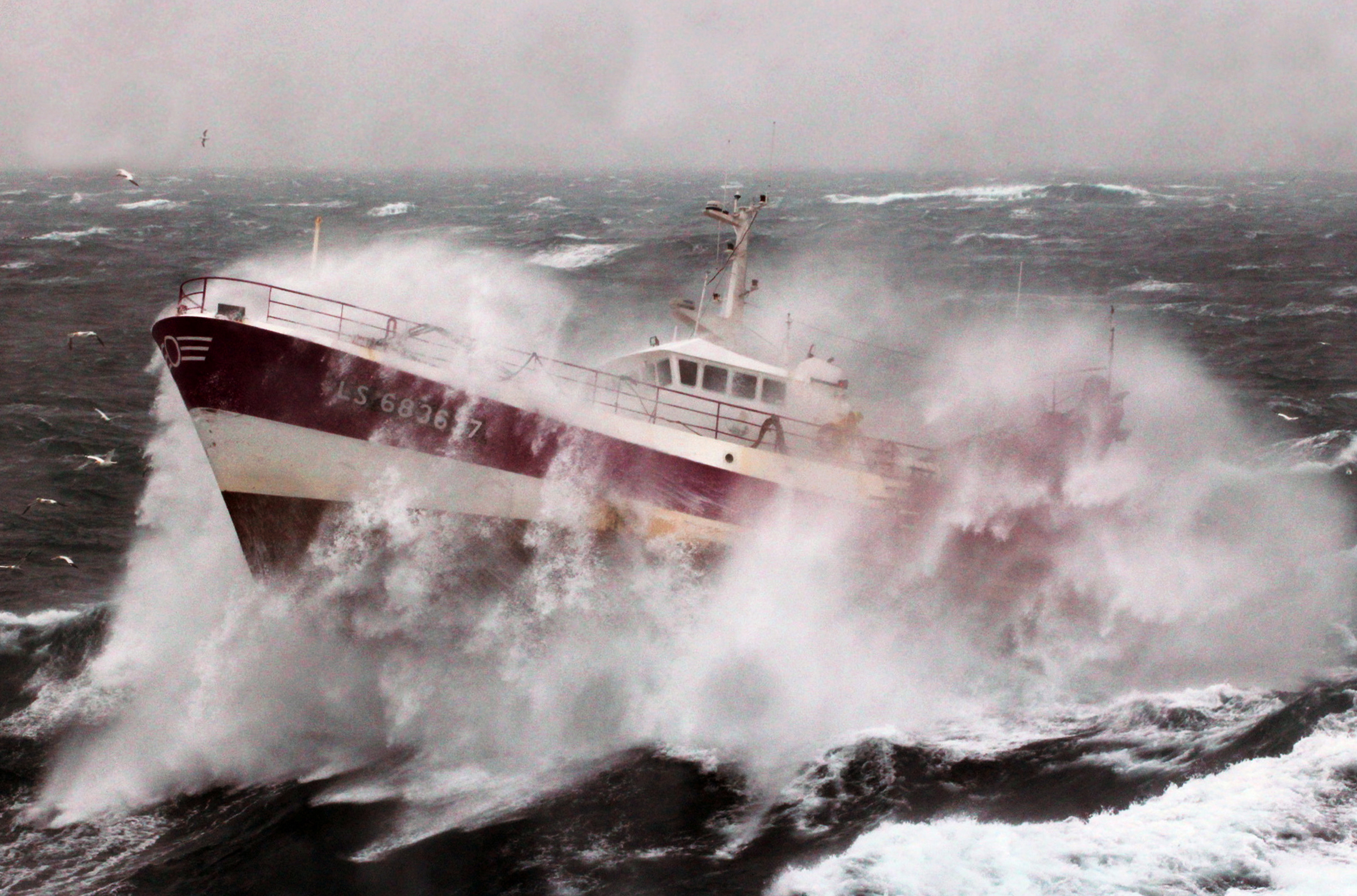
Like
the rhythm of the ant, forward progress appeared to be in fits and
starts: throb of engine, rise out of the water, slam back down and
repeat. Add nausea.
And
more nausea.
It's
not like traveling by car where you have a destination, drive a
pretty much predictable amount of time and then arrive. At sea, time
seems more elastic and reaching any sort of goal seems unlikely at
best.
I've
had the experience of looking at my watch and then spending what felt
like the next decade of my life feeling the boat get tossed around
like a liberal in a policy debate only to train my woozy eyes on the
watch and learn that only ten minutes had passed.
Some
muscle burst into the smuggler's hold where I was stashed with our
equipment, two of them.
Something
was up.
They
had already taken anything that even remotely looked like a weapon, so
whatever was going to happen was definitely not open for discussion.
One
of the muscles flexed and Captain Gurakuqi stepped into the hold.
Like
the rest of them, he had a thick phlegmatic accent, but he also had
the most curious affectation of beginning every conversation with
“How do you do?” which was pronounced in an exaggerated English
accent. It was like putting whipped cream on chili.
“How
do you do?” he asked.
It
was so convincing that I started to answer which is when one of the
muscles slammed the right side of my face into his fist.
My
ears were ringing like I had just left a rock show.
“Boat,”
said the Captain impassively with all the same emotion as if naming a
day of the week.
“Boat,”
he repeated and then pointed toward the stern.
We
were being followed which meant trouble for them and a cold swim for
me.
The
Captain started to talk to me the same way car salesmen talk to
women. He had talked to his manager and this was absolutely the best
deal for me.
One
of the muscles took a step toward me.
I
thought about what Jim had said just before he dropped me at the
pier. The Albanians were our best friends in a very bad neighborhood
and I shouldn't do anything to upset them.
I
should choose another path rather than upset these fish-bathing pricks
and their stinking taxi service.
He
was right.
That
was what I should have done.
But
I am an operator.
The
rhythm of the boat's rise and fall worked to my advantage. As I
stood up, the boat reached its apex at the crest of one wave and hung
as though frozen. The empty tins of herring that had been my
breakfast, lunch and dinner since I got on this scow stopped their
infernal rolling for just a moment.
And,
for just a moment, we waited—everyone waited—for gravity and the
laws of physics to catch up.
When
they finally did, and it seemed as though it took forever, a lot of
things seemed to happen all at once.
I
drove my hand into my pocket to find my little craft project while,
at the same time, I let my momentum carry me forward and right into
the muscle that had been staring at me the hardest and the longest.
I
had been watching him too and I knew which side he wore his knife on
and so I made sure when I stumbled into him that I pinned that arm to
his side. He might have been the baddest bad ass in the Baltic, but
I had a hundred pounds on him and that dead weight was all I needed.
I
surprised him and that was enough.
It's
not that he was a bad person, or didn't know his business. It's not
that he didn't study hard in bad ass school: I surprised him. You
can study and train, but you can't control for surprise.
We've
all been there. You do your damdest not to loose too much of a step,
but you will loose a step and, sometimes, that's all it takes. A
step is the difference between writing the after-action report and
being a statistic in it.
I
used my free arm to force the Muscle's head back and to the left as
my other hand came out of my pocket holding the claw that I had
carefully crafted out of the same tin cans that they had been so
thoughtless not to collect.
I
had nothing to do except fold and re-fold metal until I had a
workable first-strike tool and it was this that I used to pluck and
sever Mr. Muscle's carotid artery like a sous-chef veins a shrimp.
The
boat continued down into the valley between waves as I stepped away
from my fatally-surprised victim.
I
was now holding his knife by the blade as my arm came up cocked to throw
and my look was all-business.
Muscle
Number Two was transfixed.
He
looked at my knife hand, the Captain, his fallen shipmate, the knife,
the shipmate, the Captain, me. He didn't know what to do.
I
looked at the Captain and he looked at the dying muscle, then the
paralyzed muscle and then at me.
The
boat had begun to climb the next wave before the Captain spoke.
The
Albanians are a lot of things, but, above all, they are a practical
people. Pragmatic is perhaps a better word. Everybody wanted to get
home, everyone wanted to sleep in their own beds.
We
all wanted the same thing. The Captain was able to convince me that
he had not fully appreciated my position, that I was serious about
reaching my destination and that, under the circumstances, he was
prepared to take more personal responsibility to make sure that
happened.
I'm
not a prick. I can appreciate when someone is trying to work with me
and I said as much.
The
Captain smiled.
I
smiled.
Muscle
Number Two smiled.
The
boat's shifting center of gravity caused the body on the floor to
shift and sigh as the last bit of air left his lungs.
The
Captain looked.
Muscle
Number Two looked.
By
the time he looked back, he could see that my knife was now at the
Captain's neck.
I
smiled.
The
Captain smiled..., eventually.
We
had an understanding.
Ten
hours later, I was back on dry land and this was a drinking story, a
yarn that sailors tell each other in that matter-of-fact way that
both makes it easier to tell and harder to forget.
I
talk about the guy I killed, but it's not this guy. For me, he
doesn't count. It's unbelievably harsh, but I'm sure you, above all,
understand what I mean.
The
guy whose neck I broke was an accident. I was trying to protect the
mission and slow the other side down just enough for our guys to make
their play. I had not intended anything other than to slow them
down: the physics just got away from me.
On
this day, on that boat, it was a question of survival. It wasn't a
play, it was about who was going home and there was only going to be
one correct answer.
I'm
sure he was a citizen and had a past and plans for a future. There
were probably people who had loved him, who still love him. But,
like that ant, like all of us who take up this line of work, he had a
point where the risks were revealed to him, where he knew something
was different and he chose to ignore it, to keep going forward.
I
understand a lot more than I did at the time, in that moment. I
understand risk and reward and the value of strategy: all the facets
of perspective that time has given me. In that moment, however, it
was all instinct and training and focus on mission.
I
took a player off the board pawn-to-pawn. I respect that he was in
the game and that he showed up to play. I was lucky and, the more
time passes, the luckier I was.
I
could feel that ant make its way down my cheek.
It
was then that I remembered an old Raid commercial I had seen where
they talked about the invisible trail that bugs leave so that other
bugs can find their way to the nest, or to food, or whatever.
I
thought about that a lot.
Some
sort of chemical trail that other ants would be able to find and
follow.
And
then that was all I could think of: some bug spraying an invisible
welcome mat on my face.
I
did not like the idea of that one bit. Too many people had done that
to me too many times.
I
had a lot in common with that ant.
And
then..., I didn't.

No comments:
Post a Comment